Character Bible
The Quatre à Paris Cast
Five characters who drive the grammar and narrative of LAF1201. Meet them here.
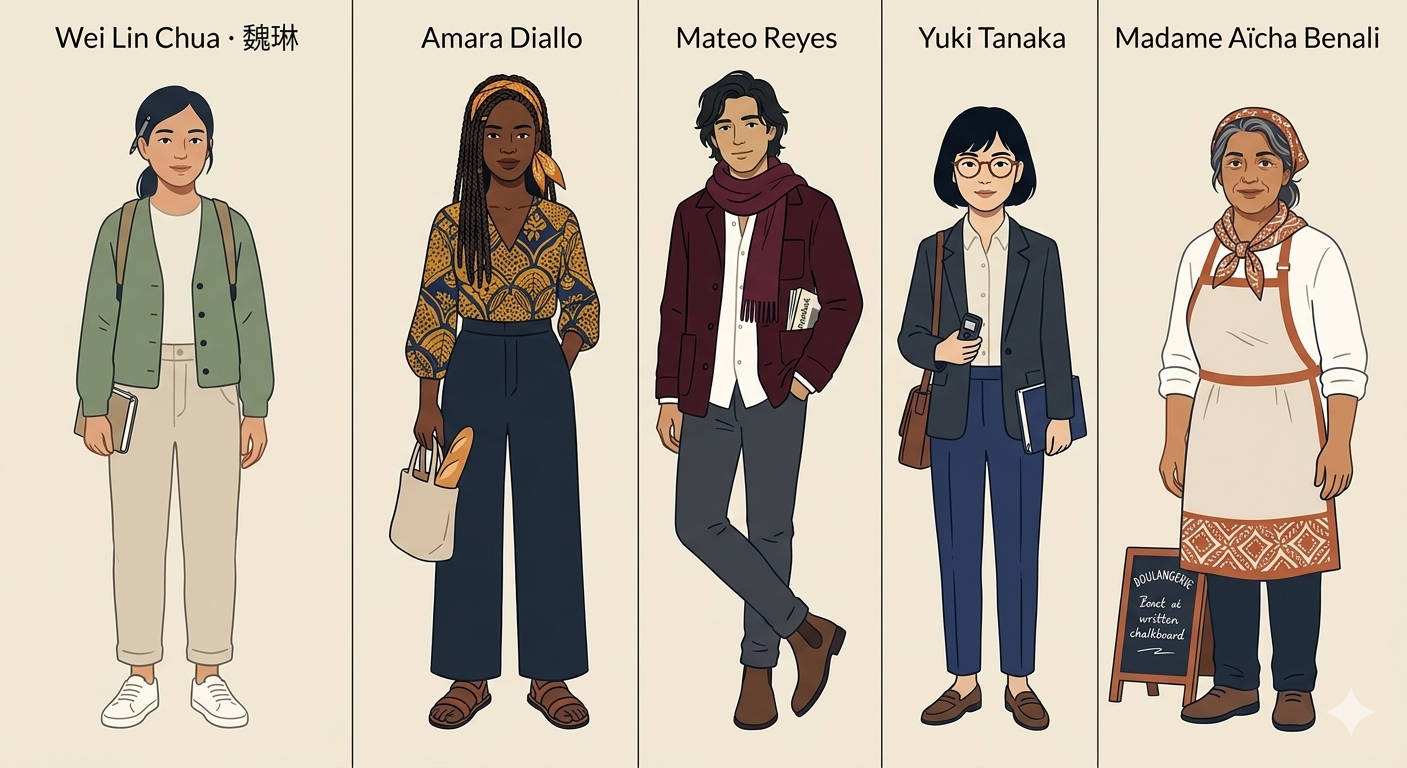
Wei Lin Chua
Wei is the mirror character: reserved, observant, writes everything down. She speaks formal French but thinks in careful steps. Her default is listening before speaking. She lives with a small hardback notebook where she sketches her understanding before committing to words. When she understands something—a grammar point, a cultural nuance—there's a quiet half-smile. She is the first to arrive at the boulangerie in Session 1, and her uncertainty about tu/vous becomes the motor for the entire first grammar unit.
Amara Diallo
Amara is the proposer: warm, confident, with an easy smile and hands that gesture when she speaks. She is from Dakar, studying in Paris, and French is her second language—she speaks it with the fluency of someone at home in the Francophone world. She anchors the Unit 4 narrative (food, preferences, the dinner party). She is generous, the one who suggests outings and brings people together. In her voice, French is a social language—a vehicle for connection, not precision.
Mateo Reyes
Mateo is the performer: animated, theatrical, always mid-gesture or mid-word. He never sits still. He's at Cours Florent learning French performance. His French is expressive but unpolished—he takes risks, speaks with his hands, sometimes makes mistakes and laughs. He is the one who forgets things (the restaurant reservation, the emails), and his comic moments anchor the Unit 2 narrative. He embodies risk-taking with language: trying constructions, playing with register, embracing error as part of the game.
Yuki Tanaka
Yuki is the recorder: poised, alert, always taking notes. She wears round glasses and carries a voice recorder and a small hardcover notebook. She is on a journalism assignment in Paris for six months, observing everything. Her French is careful and correct. She is structured, planning-oriented, the one who has the carnet and knows the train schedules. Her voice is minimal, precise—she listens more than she speaks, but when she does, it's clear and deliberate. She anchors Sessions 3 and 8 through her planning. By Session 13, her published article becomes the lens through which the semester is reframed.
Madame Aïcha Benali
Mme Benali owns and runs the boulangerie below their flat. She is the anchor of the entire narrative arc. She is warm, present, with hands always busy—wiping the counter, arranging bread, greeting customers. She has deep kind eyes, crow's-feet, and a laugh that fills the shop. Her French is fluent but inflected by her Algerian heritage; she code-switches easily between formal French and familiar registers. She remembers everyone's order. In Session 1, her simple greeting—"Tu es nouvelle, toi?"—becomes Wei's entire challenge. By the final session, her line—"C'était parfait"—closes the narrative. She is the grandmother figure, the witness, the grounding force.
How the Cast Drives the Curriculum
Each character has a signature language style that models grammar in context. Wei's formality anchors subject pronouns and tu/vous. Amara's warmth and inclusive register model polite requests and preferences. Mateo's expressive mistakes show how risk-taking and error are part of fluency. Yuki's precision models modal verbs and structured planning language. Mme Benali's fluent code-switching and familiar register anchor imperatives, questions, and the social texture of French.
The platform lessons are keyed to character anchors. The framework narrative makes those anchor moments visible to teachers. Together, the characters make grammar audible and real.