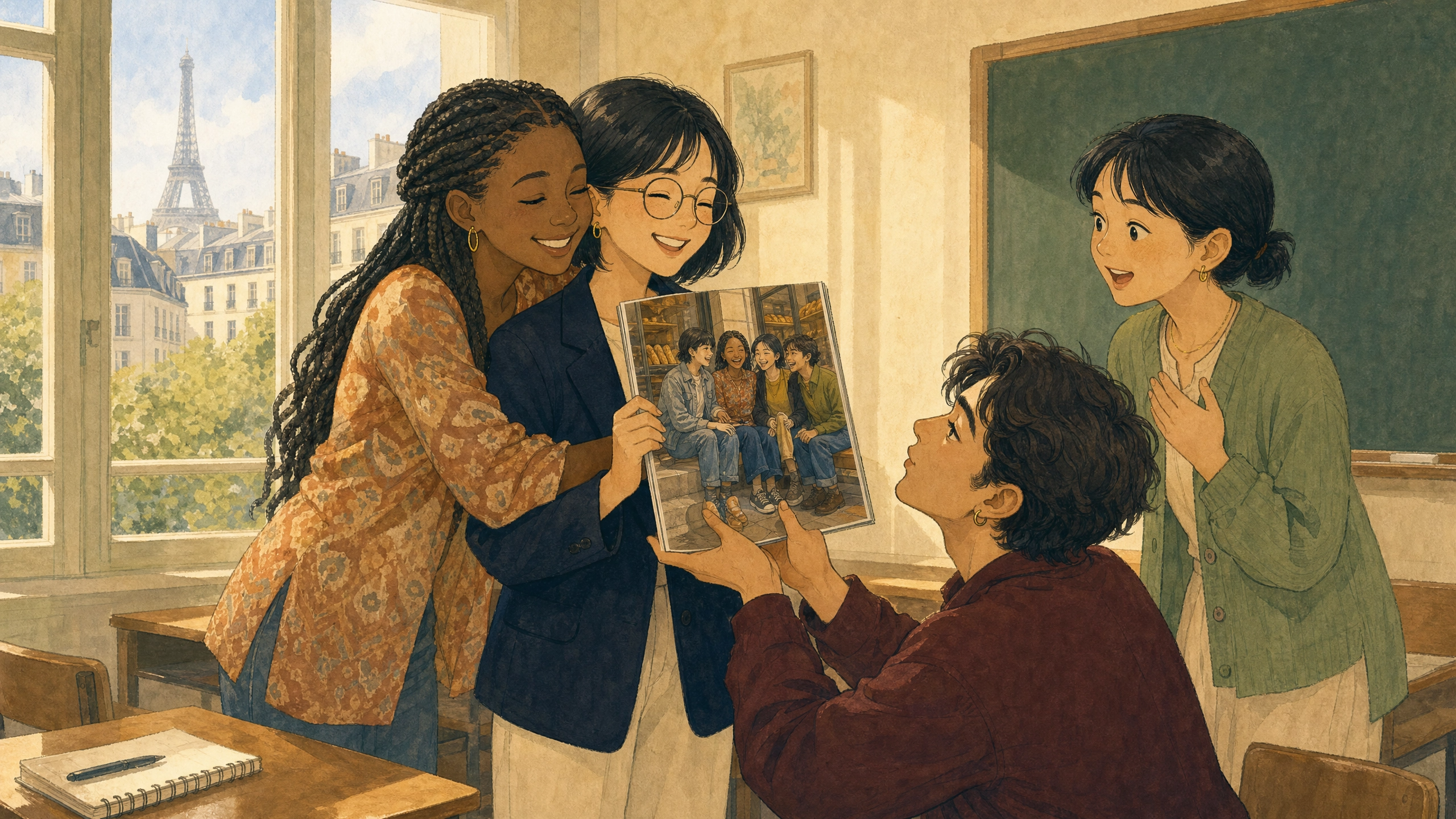
The dinner happened on Thursday evening. Nine people in the small kitchen on the second floor — which Amara had transformed, with a tablecloth and small candles and a borrowed chair from the elderly couple upstairs, into a proper dining room. Madame Benali wore a green dress. Madame Benali's son, the postman, brought wine. The schoolteacher from across the street had baked a galette. Mateo gave a small speech in three languages.
It was, in the way of small good evenings, perfect.
By Friday morning, the kitchen was a disaster. There were dishes in the sink, glasses on every surface, a single rose on the windowsill that someone had brought and that Amara, at midnight, had put in a jam jar with water. Madame Benali had left at half past midnight, after slowly hugging each of the four of them, and saying — once, simply, to nobody in particular — that they were a family.
Now it was Friday morning, and they were back in class, and they were tired, and they were happy.
— Aujourd'hui, on révise. Unité 3.
They revised, gently. The weather, the city, directions, the pronoun y. The instructor asked questions. The four of them answered. Wei answered without thinking, sometimes — the words came out before she had had time to be afraid of them. She noticed, halfway through the morning, that this was new. That she had been answering in French for weeks, but today she had been answering without preparing.
She did not say anything. But she made a small note, in English, in her notebook.
I am better than I was eight weeks ago.
In the afternoon, they revised Unité 4. Food, partitives, futur proche, the vocabulary of restaurants and shops. Most of it had been used the night before. The grammar exercises felt, for once, like a small civilised conversation about something that had actually happened.
At the end of the afternoon, the instructor gave them a writing task.
— Décrivez un repas que vous avez partagé récemment.
The four of them looked at each other. Then they wrote.
Wei's piece, when she handed it in, was eighty-four words long. It described a dinner in a small kitchen with eight other people. It described a green dress, a galette, a single rose in a jam jar. It said, near the end, that the dinner had not been complicated, but it had been important. The instructor read it that evening at home, and she made a small star next to it in green ink.
Walking back to the boulangerie that evening, Amara turned to Yuki.
— Tu écris toujours ton article ?
— Toujours.
— Tu écris sur quoi, exactement ?
— Tu verras.
Amara raised an eyebrow. Yuki kept walking.