On Wednesday morning, Mateo confessed. It happened at the boulangerie, in front of Madame Benali, which made it worse.
— J'ai oublié de réserver.
— Tu as oublié de réserver quoi ?
— Le restaurant. Pour ce soir.
Amara had wanted, before the big dinner on Friday, to take Madame Benali out for a small thank-you meal. A pre-dinner. A small private acknowledgement, from the four of them to her, for two months of croissants and warmth and slowly-spoken French. The reservation had been Mateo's only job.
Amara stared at him. Yuki sighed — a long, controlled, deeply organised sigh. Wei, surprisingly, laughed. It was the first time she had laughed openly in front of all four of them, properly, with her whole face.
— Wei, tu trouves ça drôle ?
— Désolée. C'est juste… très Mateo.
Mateo nodded. He could not argue.
— On va trouver une solution.
— Comment ?
— On va improviser !
— Mateo, on est à Paris. À sept heures du soir. Sans réservation. C'est presque impossible.
— On va surtout réfléchir.
This was Wei. She had said it very quickly. Amara turned to look at her. Wei looked surprised at herself.
— D'accord. On va réfléchir.
In class that morning, the instructor — who did not know what they were planning — happened to teach the futur proche. Aller plus the infinitive. The grammar of what is going to happen next. Je vais aller. Tu vas manger. Nous allons trouver. They drilled it for an hour. By eleven, the four of them were planning the evening entirely in the futur proche.
— On va aller au restaurant. On va expliquer. On va demander gentiment. On va trouver une table.
— Et si non ?
— On va improviser.
— Yuki, on a dit qu'on n'allait pas improviser.
— On a dit qu'on n'allait pas improviser comme Mateo.
— C'est la même chose.
They argued, gently, until lunch.
In the afternoon, in class, the instructor announced — having absolutely no idea — that they would be doing a role-play. The scene: a group of four arrives at a restaurant without a reservation. They must convince the server to give them a table. The dialogue must use the vocabulary of the unit.
The four of them looked at each other. Amara was the first to start laughing. Wei followed. Mateo, who was still slightly mortified, took a moment, and then he too started laughing.
They volunteered to go first.
It was, the instructor said afterwards, the most committed performance she had seen in fifteen years of teaching. Amara played herself. Mateo played himself. Wei played herself. Yuki played herself. The fifth student, a young man called Jean-Pierre who had been quiet all term, played the server, and he played him with the world-weary contempt of a man who had been waiting for this his entire life.
— Bonsoir. Vous avez une réservation ?
— Euh… normalement, oui.
— Mateo. Tu n'as pas réservé ?
— … J'ai oublié.
— Pardon, monsieur. On est quatre. Vous avez une table libre, par hasard ?
The role-play ran for fifteen minutes. The class applauded. Even Yuki, briefly, smiled.
That evening, the actual restaurant scene played out almost exactly the same way. The server was, against all probability, kind. He had a table by the window. He gave them his recommendation for the wine. Madame Benali — who had been told about the reservation problem only when they arrived — laughed for ten minutes when she understood what had happened, and Mateo's mortification finally dissolved.
They ate. They talked. Madame Benali told them about her own arrival in Paris in 1989, when she was twenty-one, from Algiers, and did not speak French. She told them how she had learned. She told them which boulangerie she had worked in first.
They walked home along the rue des Cinq-Diamants under a clear June sky. Friday — the big dinner — was forty-eight hours away.
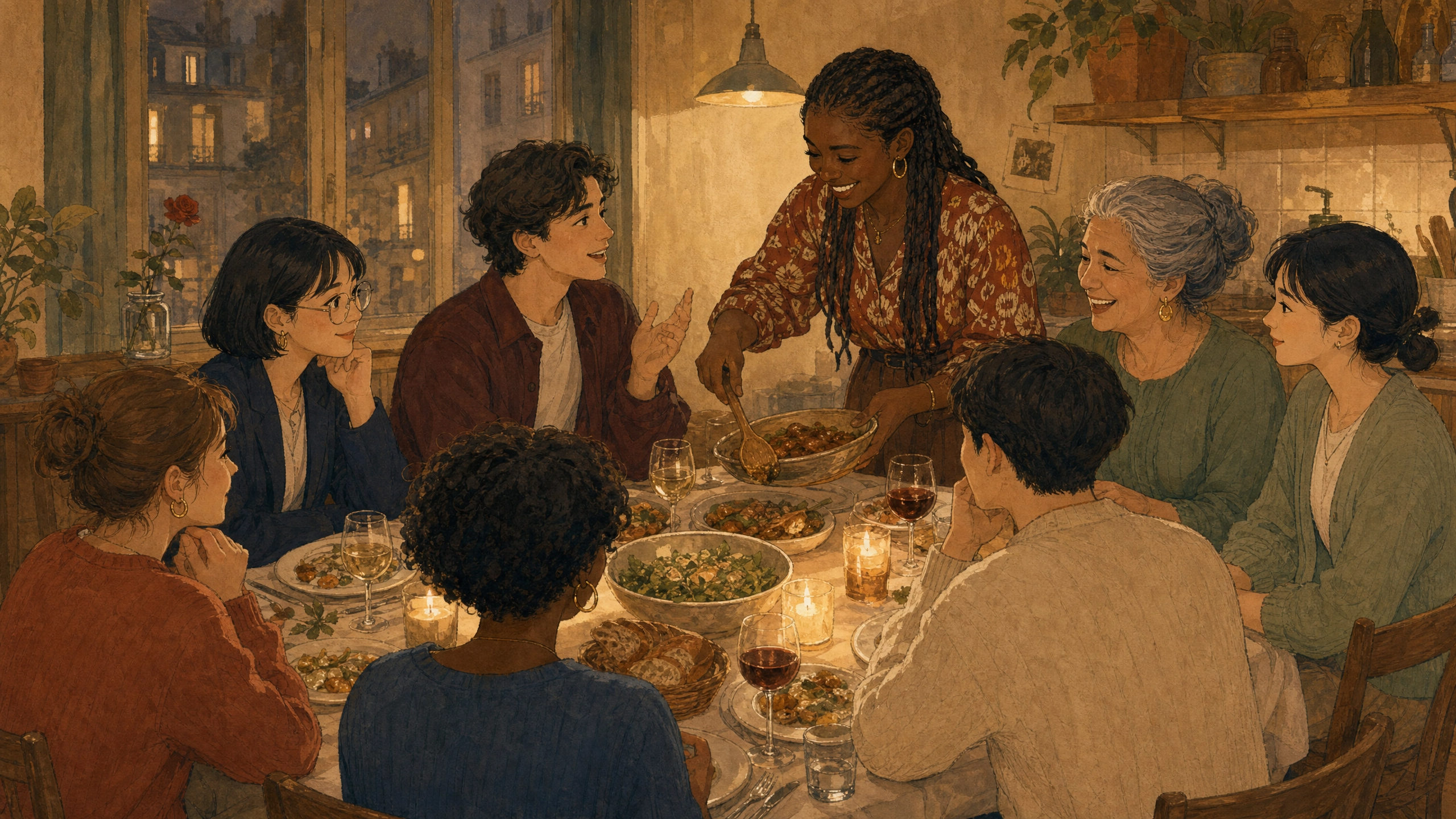
Episode 4 ends here, on a Wednesday evening in June, with five people walking slowly home, full of food and wine, and a kitchen that, two days later, would be the site of one of the small important nights of their lives.