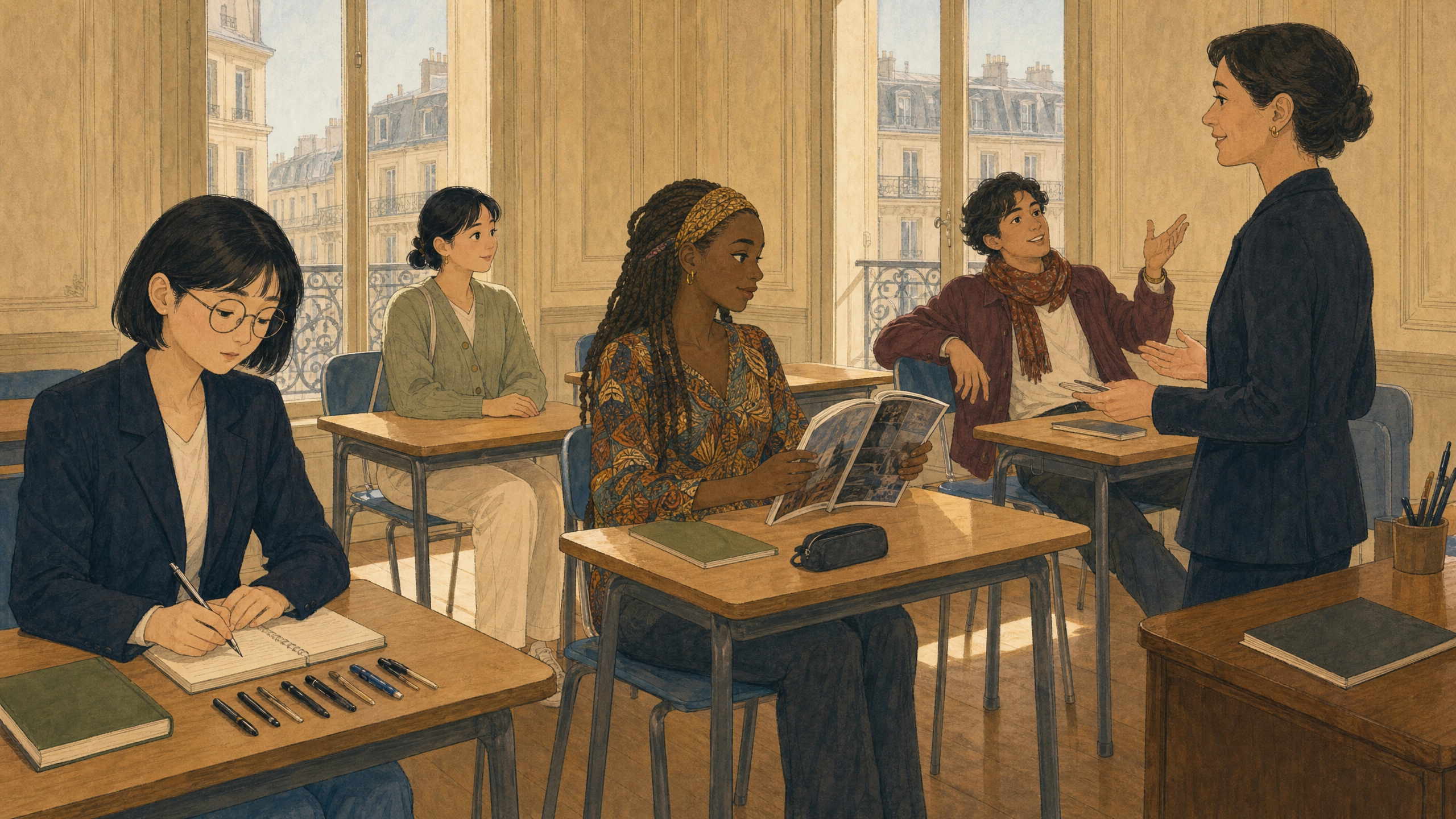
Two days have passed. The four of them have been in the same room for two mornings and two afternoons, and they have still not really spoken to each other. They have only said: Bonjour. Au revoir. Pardon. Excusez-moi. The kind of words you say to strangers in lifts.
This morning, the instructor has decided that this will end.
— Aujourd'hui, on se présente. Vraiment. Un par un. Levez-vous, dites votre nom, votre nationalité, votre profession. Allez.
Yuki goes first. She has prepared notes. Of course she has. She stands up, smooths her skirt, and reads from a small card she has clearly written the night before.
— Je m'appelle Yuki Tanaka. Je suis japonaise. Je suis journaliste. J'ai vingt-quatre ans.
Then she sits down. The whole performance has taken eleven seconds.
Mateo goes second. He stands up. He has not prepared notes. He does not need notes.
— Bonjour ! Je m'appelle Mateo. Mateo Reyes. Je suis argentin — de Buenos Aires — et je suis ACTEUR.
He says the word ACTEUR with both hands raised. Yuki, in the front row, writes something in her notebook. Amara is laughing, openly now.
Then it is Amara's turn. She does not stand up. She turns in her seat to face the class, and she speaks with the calm of someone who knows exactly who she is.
— Je m'appelle Amara Diallo. Je suis sénégalaise, de Dakar. Je suis chef. Et j'ai vingt-trois ans.
Mateo, behind her, claps. The instructor allows it.
Wei is last. Her heart is moving in a way she does not approve of. She stands up. The classroom seems very large. She opens her mouth.
— Je m'appelle Wei.
She sits down. Then she remembers. She stands up again.
— Pardon. Je m'appelle Wei Lin Chua. Je suis singapourienne. Je suis étudiante.
She sits down again, properly this time. The instructor nods.
— Très bien, Wei. Très bien.
And just like that — without anyone planning it — the four of them are no longer strangers.
After lunch, the conversation turns to where they are from.
Mateo, who has spent the entire lunch hour talking to Amara about food (he does not yet know she is a chef; she has not had the chance to tell him), turns to her now and asks the question he has been wondering since Monday.
— Amara, on parle français au Sénégal ?
Amara smiles. It is not the first time she has been asked this. It will not be the last.
— Oui, Mateo. Et au Mali. Et en Côte d'Ivoire. Et au Cameroun. Et au Québec. Et en Belgique. Et en Suisse. La francophonie, c'est grand.
Yuki, in the front row, is taking notes. Of course she is. She looks up.
— Combien de pays ?
— Vingt-neuf, je crois. Plus ou moins.
The instructor pulls up a map on the screen. The map is half-pink: France, Belgium, Switzerland, Canada, much of West Africa, parts of North Africa, parts of Southeast Asia, a few islands in the Pacific. Wei has not realised it was this big. She has thought of French as a language that belongs to Paris.
Now she looks at the map and thinks: oh.
That evening, Yuki sits at her small desk in her small apartment, two streets from the boulangerie, and writes in her notebook in Japanese. She writes: Today I learned that the Francophone world is much larger than France. I am writing my article in the wrong direction. I should start with the world, and then come back to Paris.
Then she closes her notebook. It is nine in the evening. She does not yet know that tomorrow morning, when she opens her registration packet from the school, she will discover something that is wrong.