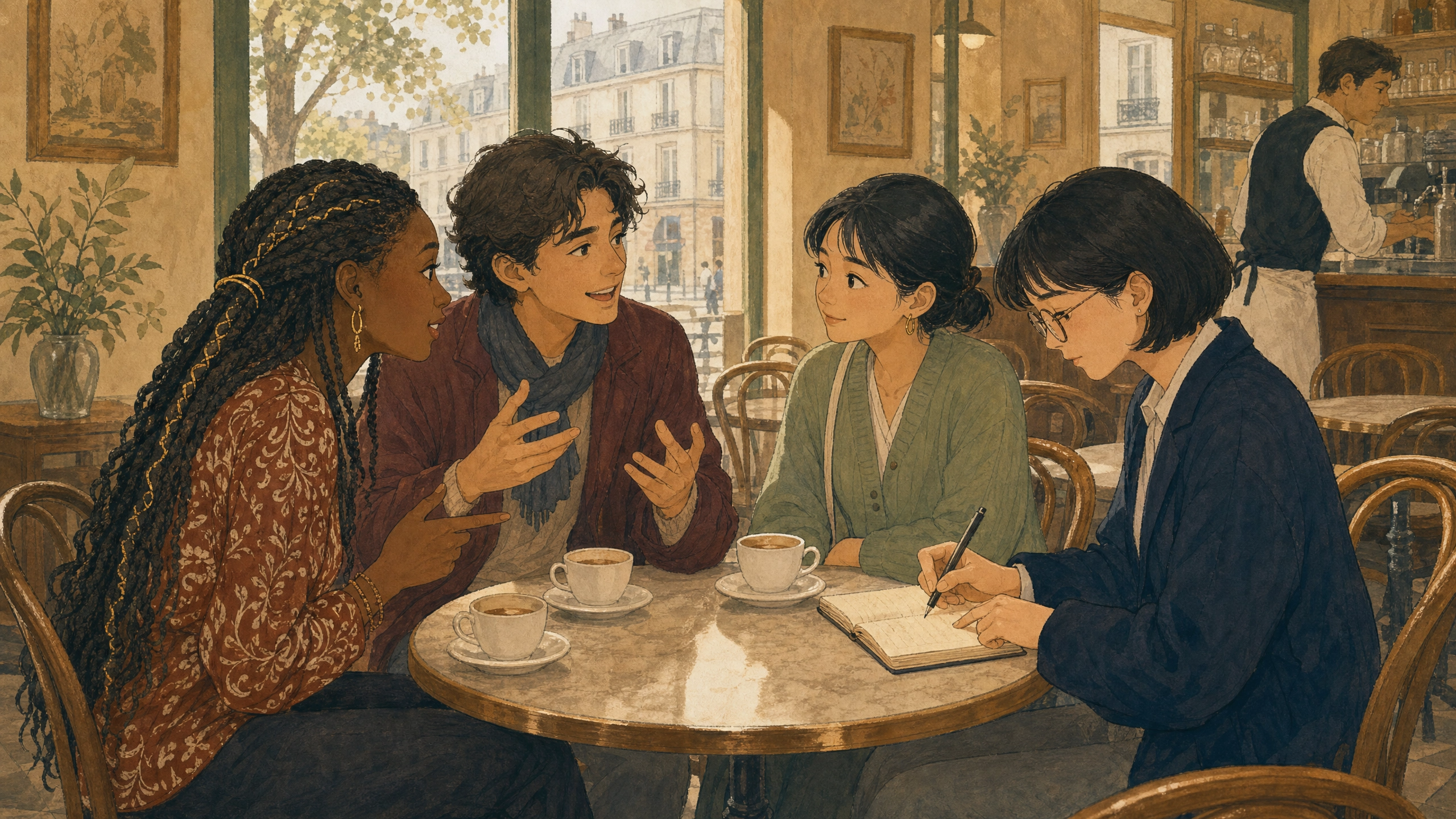
On Monday 25 May, the four of them met in the small shared salon on the ground floor of number twelve — a room with two old armchairs, a table that wobbled, and a bookshelf full of books that nobody had read in twenty years.
Yuki had brought flashcards. Forty-six flashcards. She had made them at midnight.
Amara had brought a tray of small almond cakes. She had baked them at six in the morning. She did not say this; Wei could tell from her hands, which still had a small dusting of flour.
Mateo had brought, unaccountably, a bottle of red wine. Yuki confiscated it.
— Mateo, c'est lundi matin.
— Pour la fin de la révision.
— Mateo, on révise pendant six heures. Tu ne vas pas tenir.
— Je tiens toujours.
Wei had brought nothing, because Wei had not slept well, because Wei had spent the weekend in a low panic about Friday's exam. Amara, taking one look at her, gave her an almond cake.
— Mange. On va commencer.
They started with greetings. Then numbers. Then être. Then avoir. Then s'appeler. Yuki produced flashcards at appropriate intervals. Mateo answered everything in a confident voice and sometimes in the wrong tense. Amara corrected him. Wei, slowly, began to feel less like she was going to be sick.
By the end of the morning, Wei had stopped panicking. By the end of the afternoon, she had even laughed twice — once at Mateo, once at one of Yuki's flashcards (which had a tiny precise drawing on the back). By the evening, when she went up the four flights of stairs to her own apartment, she thought: I am going to be fine.
She was not, in fact, going to be fine. She was going to be tired and slightly nauseous on Friday morning. But it was a useful thing to have thought, on a Monday evening in May.
Thursday night. The exam is in nine hours. Wei cannot sleep.
She gets out of bed at quarter past eleven and sits at her tiny kitchen table with a notebook, and she writes down everything she has learned in two weeks. She writes the French alphabet. She writes the numbers from zero to sixty-nine. She writes je suis, tu es, il est, elle est, nous sommes, vous êtes, ils sont, elles sont. She writes them again. She writes je m'appelle, je suis singapourienne, j'ai vingt et un ans.
She writes for an hour. The list gets longer. The list also, somehow, makes her feel calmer.
At twelve thirty, she hears footsteps on the stairs. The footsteps go down — not up. She listens. There is the sound of someone moving around in the kitchen on the floor below.
Wei wraps a cardigan around her shoulders and goes downstairs.
Amara is in the small kitchen on the second floor, which is technically Yuki's kitchen but which Amara seems to have unofficially adopted. She is putting something into the oven. She is wearing a t-shirt and jeans and she does not look like a person who has been asleep.
— Wei. Tu ne dors pas ?
— Non. Toi non plus ?
— Je fais des gâteaux pour demain. Pour après l'examen. Pour la chance.
Wei sits down at the small kitchen table. The clock on the wall says twelve thirty-three.
Amara sits down opposite her.
— Wei, écoute-moi. Demain, ça va aller. Tu sais beaucoup. Tu sais plus que tu penses.
— Tu crois ?
— Je sais.
They sit together for forty minutes, drinking tea — Amara has made tea — and quietly going through tu/vous distinctions in French, and laughing once or twice, and Wei goes back upstairs at one fifteen and falls asleep in seven minutes.
The next morning, on the way to the exam, Madame Benali gives each of them a croissant.
— Pour la chance, mes enfants.
Amara smiles. Mateo says it is going to be a triumph. Yuki adjusts her pen. Wei does not say anything. But she is not afraid.