The exam happens. There is not very much to say about it, because exams happen the same way everywhere: silence, paper, a clock that moves slowly, and then suddenly very fast at the end.
In the morning, there is the listening section. Wei listens to four short conversations and answers questions. The voices on the recording are clear; they speak slightly slower than real life, which is a kindness; she gets most of the answers and is fairly sure about the others.
Then there is the reading section. A short text about a young woman in Lyon. A form to complete. A postcard from a friend in Brussels. Wei reads each one twice, the way Amara told her to. She answers calmly. She does not panic when there is a word she does not know — Amara has told her, also, that you do not need every word to understand a sentence.
At eleven thirty, the listening and reading section ends. There is a fifteen-minute break.
Wei steps out into the corridor. Mateo, in the corridor, is silent. Mateo is never silent. Yuki is silent too, but Yuki is often silent. Amara is the first to speak.
— Comment ça va ?
— Ça va. Je crois.
— Mateo ?
— Triomphe.
— Triomphe ?
— Triomphe. Probablement.
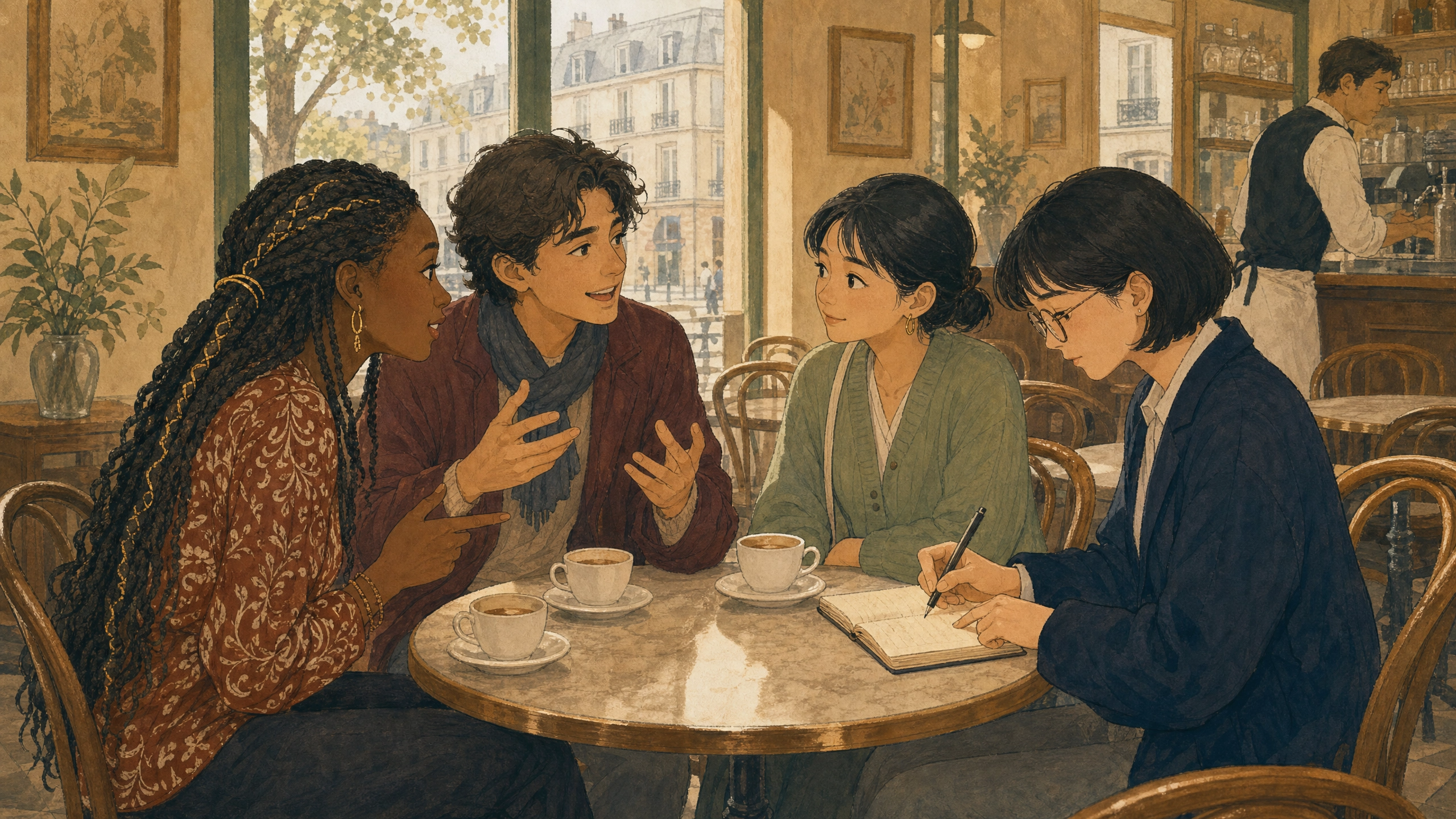
Amara laughs. They drink water from a fountain in the corridor. They do not look at their phones. They do not talk about the exam. They simply stand together in a small silent group, four people who have been quietly preparing each other for this morning for two weeks.
At eleven forty-five, the second half begins.
The writing section is forty minutes. Wei writes a short email — to a fictional cousin who is coming to Paris next month — describing what they should bring, what the weather is like, and what they will do together. She uses the structures she practised on Thursday night. Je suis, j'ai, je vais. The email is, by the end, eighty-three words long. She rereads it. She is satisfied.
The speaking section is the part she has been afraid of. She is called in last, alphabetically. Mateo goes first (and exits the small examination room with his thumbs up). Yuki goes second (silent, focused). Amara goes third (already laughing, before the door closes).
Then it is Wei's turn. She walks into the small room. There is the instructor, who smiles at her. There is a second teacher she has never seen before, who is the assessor.
— Bonjour, Wei. Asseyez-vous. Vous êtes prête ?
— Oui, Madame.
The instructor asks her three questions. What is your name. Where are you from. What do you like to do on the weekend. Wei answers each one carefully. The instructor nods. The second teacher writes something on a piece of paper.
Then the second teacher asks her one more question — not from the script, just a real question.
— Et vous habitez où, à Paris ?
Wei smiles. This one she knows.
— J'habite au-dessus d'une boulangerie. Au numéro douze, rue des Cinq-Diamants. Je vis avec trois amis. On est arrivés tous les quatre le même jour. C'est… c'est une coïncidence. Mais c'est aussi une famille.
The second teacher looks up from her paper. She is no longer writing. She is smiling.
— C'est une belle réponse, Wei. Merci.
Wei walks out of the room. The other three are waiting for her in the corridor. Amara looks at her face.
— Ça s'est bien passé.
— Oui.
Episode 2 ends here, in a corridor at twelve minutes past two on a Friday afternoon, with four people who do not yet know their results but who are no longer afraid of the next part.