The plan held for three hours.
They started at ten at the marché aux puces, exactly as Yuki had specified. Amara was in her element — bargaining with a fishmonger over the price of a small wheel of cheese, even though they were not buying cheese, simply for the pleasure of it. Wei photographed everything. Yuki took notes. Mateo, briefly, was a model citizen.
They had lunch at twelve thirty in the eleventh, at a small Lebanese place Yuki had researched. The food was good. They were laughing. The plan was holding.
At one fifty-five, they were walking past the rue Mouffetard, on their way back to the metro to go to the museum, when Mateo heard the brass band.
It was not a large brass band. It was four people — a trumpet, a tuba, two clarinets — playing something cheerful on the corner of a small square. Mateo stopped walking. The other three did not notice, immediately, because they were ahead of him.
By the time they noticed, Mateo was thirty metres behind them, dancing — actually dancing — to the brass band, with two French children who had also stopped to watch.
— Mateo !
— Une minute !
It was not a minute. It was twenty minutes. By the time they had retrieved Mateo, they had missed the metro window for the museum, and the schedule was beginning to slip. Yuki, in a calm voice that was much more concerning than a loud voice would have been, suggested they recalibrate.
They did not recalibrate. They split up. Amara wanted to walk to the canal directly. Mateo wanted to find another brass band. Wei said she would go ahead to the metro and meet them there. Yuki, alone of the four, said this was a bad idea.
Wei went to the metro. Wei went to the wrong metro. Wei realised she was at the wrong metro half an hour later, when she got off at a station called Stalingrad and recognised nothing.
She was alone. Her phone had two percent battery. The signs were in French, of course they were, and she had practised reading them, but reading a sign in a textbook is different from reading a sign when you are lost.
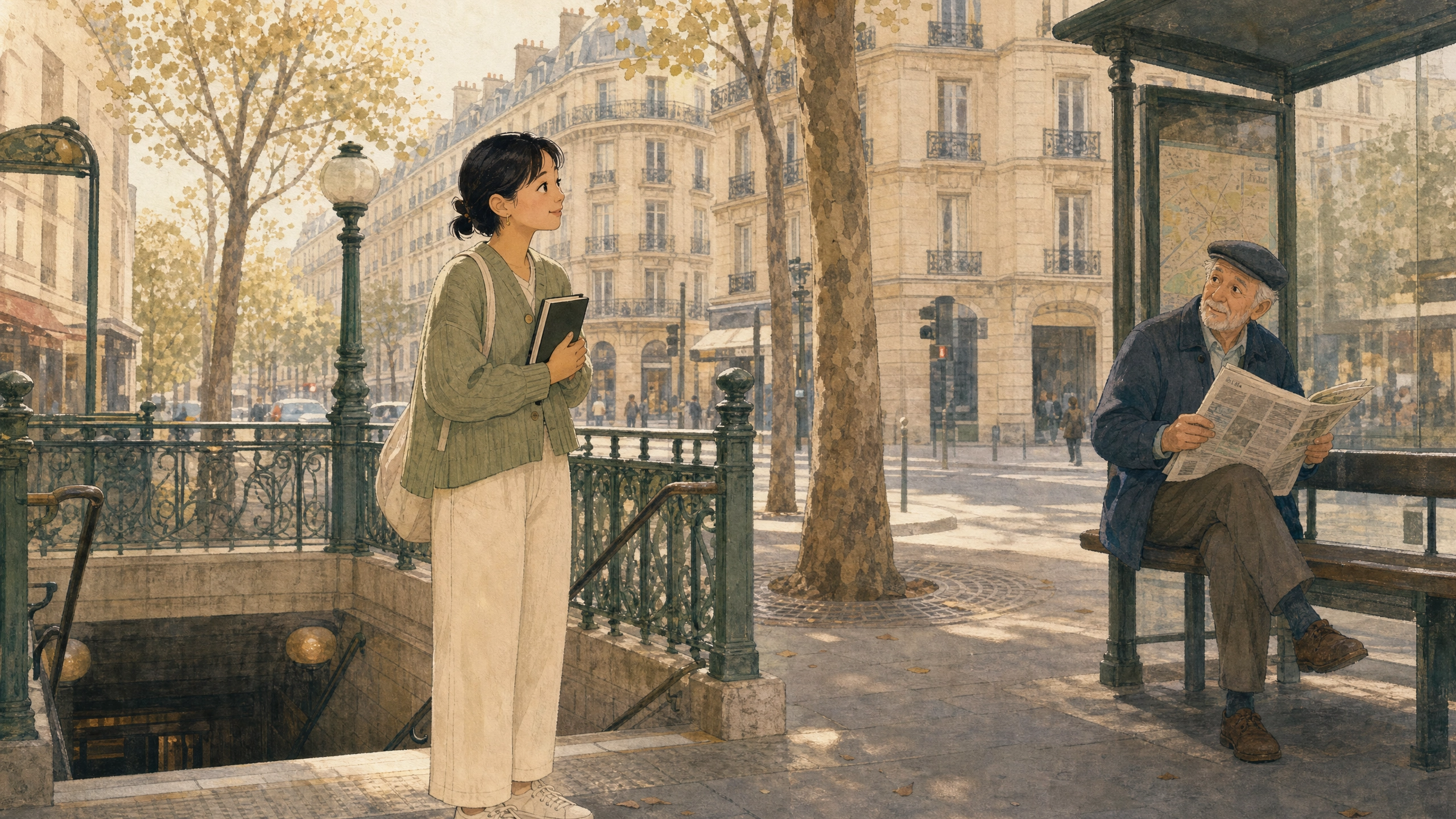
She breathed. She looked around. There was an older man waiting at a bus stop. He had a kind face. He was reading a newspaper.
Wei walked over. She rehearsed the sentence twice in her head. Then she said it.
— Excusez-moi, monsieur. Je suis perdue.
The man lowered his newspaper. He looked at her. He did not look in a hurry.
— Pas de problème. Vous allez où ?
And Wei, slowly, sentence by careful sentence, asked her way home — and the man, slowly, sentence by careful sentence, told her. He told her twice. He drew a small map on the back of his newspaper. He told her she was very brave to ask in French. He told her she was already nearly there.
Wei got back to the rue des Cinq-Diamants at six fifteen that evening. Amara was sitting on the front step of the building. When Amara saw her, she stood up, and she did not say anything, and she gave Wei a hug.
— On était inquiets.
— Je sais. Pardon.
— Non. Tu as fait quelque chose de courageux.
Madame Benali, who had been watching from her shop, came out with a small bag of three pains au chocolat, and gave them, in silence, to Wei.
On Friday afternoon, after class, something unusual happened.
Madame Benali — who had been watching the four of them carefully all week, in the way that a woman who has run a boulangerie for thirty-five years watches everything — came out from behind her counter and turned the small sign on the door from OUVERT to FERMÉ.
— Venez. Tous les quatre. Dans l'arrière-boutique.
They followed her. The arrière-boutique — the back room of the shop — was small and warm and smelled of bread. There was a wooden table, four chairs, and a kettle. Madame Benali made them tea. She did not say anything for a few minutes, just moved around the room with the small confident movements of a person who knew exactly where everything was.
Then she sat down.
— Maintenant. Vous allez planifier quelque chose. Quelque chose de bien. Et vous allez m'inviter.
They looked at each other.
— Quelque chose comme quoi, Madame ?
— Décidez. C'est vous, les jeunes.
They sat in the back room for two hours. They drew up an itinerary that did not collapse. They learned the words for prendre le métro, descendre à la station, traverser la rue. They learned the pronoun y, which meant there, and which Mateo immediately overused (j'y vais, on y va, tu y vas, il y va) until Yuki begged him to stop.
By the end of the afternoon, they had also agreed, without anyone really proposing it directly, that the next big thing they were going to do together would not be an outing. It would be a dinner. A proper one. In the small shared kitchen on the second floor. With Madame Benali invited.
Amara, who would do most of the cooking, was already making a list.
Episode 3 ends here, in the back room of a boulangerie in the thirteenth arrondissement, on a Friday in June, with four people who have just decided to throw a dinner party for the woman who has been feeding them for two months.