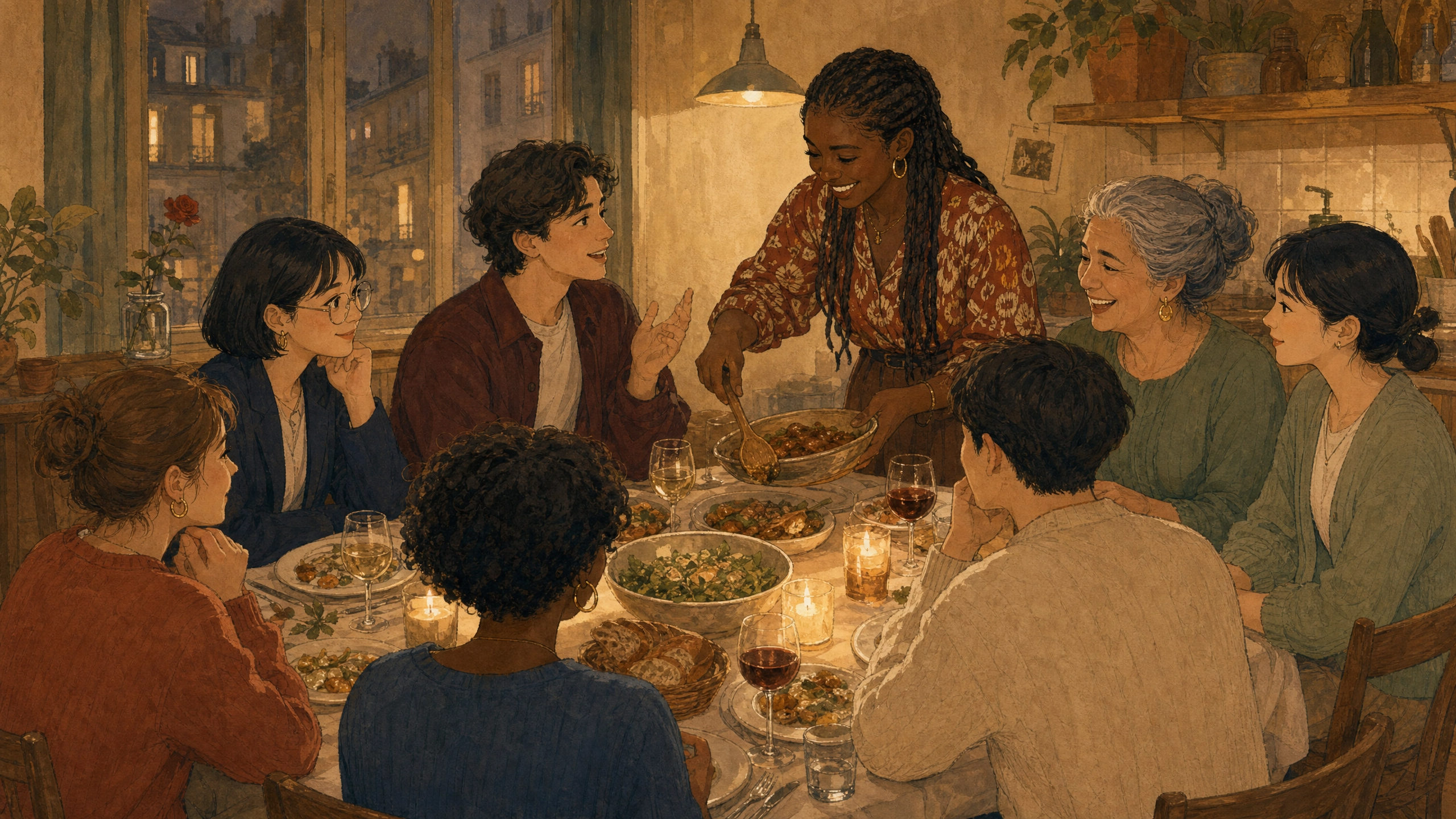
On Monday morning, Amara had become a project manager.
She had spent the weekend writing. She had written a menu (thieboudienne, the Senegalese rice-and-fish dish her grandmother used to make; a salade niçoise, as a small homage to France; cheese; a tarte aux fruits for dessert). She had written a budget (sixty euros, divided into categories). She had written a guest list (Madame Benali; Madame Benali's son, who was a postman; the elderly couple from the third floor; the schoolteacher from across the street; the four of them; total: nine people).
She had also written, in small careful handwriting, a list of jobs.
— Yuki, le budget. Tu suis l'argent.
— Acceptée.
— Wei, la logistique. Les courses, le timing, la liste.
— D'accord.
— Mateo.
— Oui ?
— Tu es maître de cérémonie.
— Quoi ?
— L'ambiance. La musique. Le discours. Tu fais ce que tu fais bien.
Mateo looked, briefly, as if he might cry from happiness. Yuki wrote the assignments down, in three columns, in her notebook.
In class that morning, they learned the vocabulary they would need. Manger, boire, food, drink, eating habits. Frequency adverbs — toujours, souvent, parfois, rarement, jamais — which Wei found beautifully precise. They went around the classroom, each person describing their habits.
— Je mange du riz tous les jours.
— Je bois beaucoup de café.
— Je ne mange jamais de viande le matin.
— Je mange parfois trois croissants au petit-déjeuner. — Mateo, tu es ridicule.
They were ready. The shopping was that afternoon.
The marché de la Place d'Aligre is a real place, and on a Monday afternoon in June, the four of them descended on it with a list.
Amara went to the fishmonger first. She negotiated. She had been negotiating with fishmongers since she was seven; this was, for her, recreational. The fishmonger, a man with thick eyebrows, raised his price. Amara raised hers. They argued cheerfully for five minutes, in French that Wei could understand maybe forty percent of, and then they shook hands and Amara walked away with a kilo and a half of poisson at a price that Yuki, watching the transaction, recorded with reverence.
Yuki tracked every centime. She had a small calculator. She also had a small pencil, and she had brought a small clipboard.
— Yuki, c'est un marché. Pas un audit.
— C'est les deux.
Wei read every label carefully, because Wei had discovered, over the past two weeks, that French food labels were a small efficient way of practising vocabulary. She bought tomatoes (un kilo), onions (un demi-kilo), garlic (six gousses), lemons (quatre), and a bunch of fresh coriander that the woman selling it called persil arabe.
Mateo got distracted by an accordionist.
This was inevitable. The accordionist was playing something melancholic at the corner of the square. Mateo stood for ten minutes, listening, and then put five euros in the man's hat. When he came back to the others, he was slightly tearful.
— C'était magnifique.
— Mateo, tu as les fromages ?
— Les fromages !
He had not bought the cheeses. He went back. He returned, twenty minutes later, with three cheeses (un comté, un brie, un chèvre), a small bottle of olive oil he had not been asked to buy, and a story about the woman at the fromagerie that they did not have time to listen to.
By six in the evening, the four of them were back at number twelve, rue des Cinq-Diamants, with eight bags of food, sixty-two euros and forty cents of receipts (Yuki had checked), and a kitchen that needed to be cleaned before tomorrow.
They cleaned it. They cleaned it together. By eight, they had stopped speaking French and were singing along to something Mateo had put on his speaker.
None of them yet knew that on Wednesday, Mateo would forget something important.